

You’ve been congested for a week. Your face hurts when you bend over. You’re tired of blowing your nose, tired of mouth-breathing at night, and tired of feeling like there’s a bowling ball behind your eyes. The question on your mind is simple: do I just need to wait this out, or do I need antibiotics?
Here’s the honest answer: the vast majority of sinus infections are viral, and antibiotics won’t do a thing for them. Roughly 90% of sinus infections in adults are caused by viruses — the same family of germs that cause the common cold. Antibiotics only kill bacteria. Giving you amoxicillin for a viral sinus infection is like trying to fix a flat tire with a screwdriver.
That said, sinus infections can turn bacterial, and when they do, antibiotics genuinely help. The trick is knowing the difference. This guide walks through how to tell a cold from a true sinus infection, when bacterial infection is likely, and when a same-day visit makes sense.
What’s actually going on in your sinuses
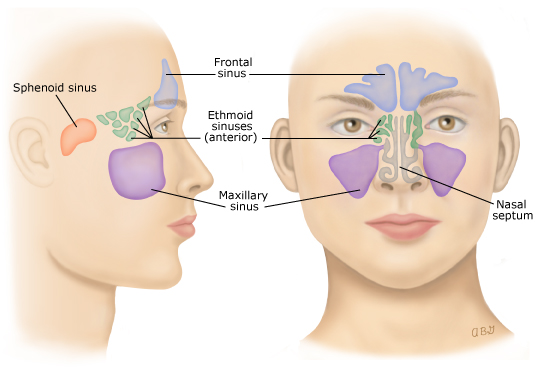
Your sinuses are hollow, air-filled spaces in your skull — behind your forehead, cheeks, and the bridge of your nose. They’re lined with mucus-producing tissue and are connected to your nasal passages through small openings. When you catch a cold, the lining of your nose and sinuses gets inflamed. The openings swell shut. Mucus that normally drains gets trapped. Pressure builds. That trapped, stagnant mucus is what creates the classic “sinus infection” feeling — even when the underlying cause is still just a cold virus. This is why most sinus infections start out viral. A cold causes blockage. Blockage causes pressure and pain. Pressure and pain feel like a sinus infection — because, technically, they are one. The medical term is viral rhinosinusitis, and it usually resolves on its own in 7 to 10 days.
Cold vs. sinus infection: how to tell them apart
The honest truth is they overlap a lot in the first week. Both can give you congestion, runny nose, post-nasal drip, mild facial pressure, fatigue, and a low-grade headache. The differences become clearer as time passes.
A typical cold peaks around days 3–5 and starts improving by day 7. Symptoms are diffuse: stuffy nose, sore throat, mild cough, general crumminess. Facial pain is usually mild or absent.
A sinus infection tends to localize. The pressure and pain concentrate behind your forehead, cheeks, or eyes. Bending forward makes it worse. Mucus may turn thick and discolored. The feeling is heavier and more focused than a typical cold.
The duration test is the most reliable single clue. If you’re still miserable beyond day 10, or if you started getting better and then got dramatically worse around day 5 or 6, you’re more likely dealing with a true sinus infection — and possibly one that has turned bacterial.
When a sinus infection is likely bacterial
Clinical guidelines from the Infectious Diseases Society of America point to three patterns that suggest a bacterial sinus infection rather than a viral one:
- Symptoms lasting more than 10 days without improvement. A viral infection should be trending better by then. If you’re on day 12 and still feel like day 4, that’s a red flag.
- Severe symptoms from the start. Fever above 102°F, intense facial pain, and thick purulent (pus-like) nasal discharge in the first 3–4 days suggests bacterial involvement from the get-go.
- “Double sickening.” You started feeling better around day 5 or 6, then got significantly worse. This pattern — viral infection clearing the way for bacterial overgrowth — is one of the most reliable indicators.
If one of these three patterns describes your situation, an antibiotic is reasonable to consider. If none of them do, antibiotics will almost certainly not help and may cause side effects (stomach upset, yeast infections, antibiotic resistance) without any upside.
What about colored mucus?
This is one of the most persistent myths in primary care: green or yellow snot means you need antibiotics. It doesn’t. Color changes happen because your immune system sends white blood cells (specifically neutrophils, which contain a green-tinged enzyme) to fight the infection — viral or bacterial. Cloudy yellow or green mucus is a sign your immune system is working, not a sign of bacteria specifically.
Color alone should never decide whether you need antibiotics. Duration, severity, and pattern matter far more.
What you can do at home that actually works
For most sinus infections — especially in the first 7 to 10 days — symptom management is the goal. The good news is that several home treatments have solid evidence behind them:
Saline nasal irrigation. A neti pot or squeeze bottle with sterile saline (use distilled, boiled, or filtered water, never tap) is one of the most effective things you can do. Done twice a day, it physically flushes mucus and inflammatory debris out of your sinuses. Multiple studies show meaningful symptom reduction.
Steam inhalation. A hot shower or a bowl of hot water with a towel over your head opens drainage and thins mucus. Cheap, safe, and surprisingly effective.
Decongestants. Pseudoephedrine (the kind kept behind the pharmacy counter) works well for short-term use, but limit to 3–5 days to avoid rebound congestion. Phenylephrine (the over-the-counter version) has been shown to be largely ineffective — save your money.
Intranasal steroids. Fluticasone (Flonase) and similar OTC nasal sprays reduce inflammation in the sinus lining. They take a few days to kick in, so they’re worth starting early.
Hydration, rest, and pain control. Acetaminophen or ibuprofen for pain and pressure. Plenty of fluids. Sleep on a slight incline to help drainage overnight.
When you need to be seen the same day
Most sinus infections don’t need urgent evaluation. But some symptoms genuinely do, and these are worth memorizing:
- High fever (above 102°F) with severe facial pain
- Vision changes, eye pain, or swelling around the eyes
- Severe headache not relieved by over-the-counter medication, especially with stiff neck or confusion
- Swelling or redness on your face, especially around the eyes or forehead
- Symptoms in someone immunocompromised — cancer treatment, organ transplant, uncontrolled diabetes, certain medications
These can signal complications like orbital cellulitis or, rarely, infection spreading to deeper structures. They warrant in-person evaluation, not telehealth.
When telehealth is the right call
For an otherwise healthy adult with classic sinus infection symptoms — especially if you’re past day 10 without improvement, experiencing “double sickening,” or dealing with severe symptoms but no red flags — a virtual visit with a licensed clinician is a reasonable, efficient option. A good provider will:
- Take a careful history and ask the right questions about duration, pattern, and severity
- Walk through the red-flag checklist with you
- Recommend antibiotics only if the clinical picture genuinely warrants them — and explain why if it doesn’t
- Send a prescription to your pharmacy if appropriate, or give you a clear plan for home management if not
The goal isn’t to hand out antibiotics on demand. Antibiotic stewardship matters — both for your own gut health and for slowing the broader resistance crisis. The right answer is sometimes “here’s a prescription, take it for 5–7 days,” and sometimes it’s “this is viral, here’s a symptom-management plan, follow up if you’re not better in 5 days.” Both are good visits.
The bottom line
If you’ve been sick for less than 7 days, you almost certainly have a viral infection that doesn’t need antibiotics. If you’re past 10 days without improvement, got worse after starting to recover, or had severe symptoms from day one, a bacterial sinus infection is more plausible and worth a clinical evaluation.
You don’t need to drive across town and sit in a waiting room to get this question answered. A 10-minute virtual visit with a California-licensed clinician can give you a real assessment, a real plan, and an antibiotic prescription if — and only if — you actually need one.
Horizon Rx is a California-licensed concierge telemedicine practice offering same-day virtual visits for uncomplicated urgent care needs. Visits are $99 flat, cash-pay, with no insurance required. Book a same-day appointment.
This post is for general educational purposes and is not a substitute for individualized medical advice. If you’re experiencing high fever, vision changes, severe headache, or facial swelling, please seek in-person care.


